

When you’re suspending battens, drapery, scenery, lighting and sound equipment, you can’t afford to miscalculate loads. The safety of your crew and performers depends on your ability to understand load limits and distribute weight appropriately.
Doing so not only keeps you compliant with industry standards and reduces your liability but also builds trust. When your staff knows they can rely on your rigging decisions, they can focus on delivering visually engaging performances.
Read on to learn more about theatre rigging load limits.
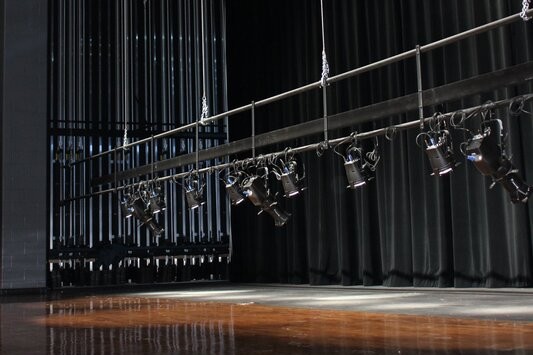
What are Theatre Rigging Load Ratings?
A load rating is the maximum force that rigging equipment is designed to handle under normal operating conditions. The load rating is set by the rigging manufacturer and applies to hardware like battens, shackles, turnbuckles and eyebolts. Each component carries its own load rating, but the system as a whole is only as strong as its lowest-rated piece.
Ratings are determined through testing under static conditions to define an operational margin of safe use. The American National Standards Institute outlines design factors for counterweight systems, while the Occupational Safety and Health Administration enforces legal compliance with those standards.
Types of Theatre Rigging Loads
Static load: A static load is any weight that doesn’t change or move and serves as the baseline for which all rigging equipment is rated.
Dynamic load: A dynamic load is the weight of an object and the pressure added by acceleration, deceleration and swinging. It increases the weight applied to your rigging due to the dynamic force required to start or stop motion.
Point loads: Weight and force are applied to a single location in point loads. That concentrated force creates localized stress that the hardware must be rated to handle. Point loads are often created when you suspend lighting and sound equipment.
Distributed loads: A distributed load on theatre rigging is spread evenly across the length of a structural element. All points bear the same pressure, reducing the strain and bending on suspended hardware.
Key Load Rating Terms You Should Know
Working load limit (WLL): This is the maximum load a piece of rigging equipment can support under average working conditions. The lowest WLL anywhere in your system dictates the maximum load for the entire setup. You should never exceed it on any component. The WLL should be marked on your equipment.
Breaking strength: This is the maximum weight that theatre rigging can handle before failing. It usually exceeds the WLL and is established with testing in controlled environments. Breaking strength is a laboratory measurement, not an operational limit, so don’t select or load equipment based on that number.
Safety and design factor: The design factor is determined by dividing the breaking strength by the WLL. It quantifies a buffer built to account for real-world variables such as wear, cyclic loading, environmental exposure, and installation variance.
Calculating Theatre Rigging Load with Multiple Attachment Points
Before you can calculate the load for multiple rigging points, you need to locate the suspended element’s center of gravity. Once you’ve identified the balance point, you divide the element’s total weight by the number of connection points to determine how much weight each attachment will bear. While dividing total weight by the number of connection points gives a baseline estimate, load distribution is rarely equal in practice.
For any complex hang or high-stakes application, a structural engineer should be involved to verify load distribution and confirm compliance. They analyze the system’s equilibrium and motion using mathematical tools to ensure your equipment complies with industry standards.
Best Practices for Staying Within Load Limits
Calculate WLL before use: You should never elevate an object until you understand the working load limit for the entire system. That includes battens, attachment hardware, lift lines and anchor points. Even a single backdrop can create unexpected load concentrations if the weight distribution isn’t calculated in advance.
Create a culture of safety: Consistency is essential when implementing safety practices in theatre settings. Every stagehand and technician holds a share of the responsibility for proper rigging installation and load limit adherence. Regular training, inspections and communication reduce the risk of human error and help your team keep their skills sharp.
Maintain accurate records: Record every piece of rigging equipment, its load ratings and maintenance work. That documentation helps you identify issues before they become serious and gives inspectors evidence of your compliance with safety standards.
Know when to retire equipment: Rigging equipment degrades over time, so you may not notice that your hardware has reached the end of its service life right away. Be mindful of load history, visible wear, inspection findings and manufacturer recommendations when considering equipment retirement.
Theatre Rigging Installation and Inspections at Tiffin Scenic Studios
Effective theatre rigging requires training and expertise. Tiffin Scenic Studios has decades of experience equipping, installing and inspecting theatre equipment to promote safe performances and presentations. Our work extends across the United States. Learn more about our services and contact us to schedule a consultation.