

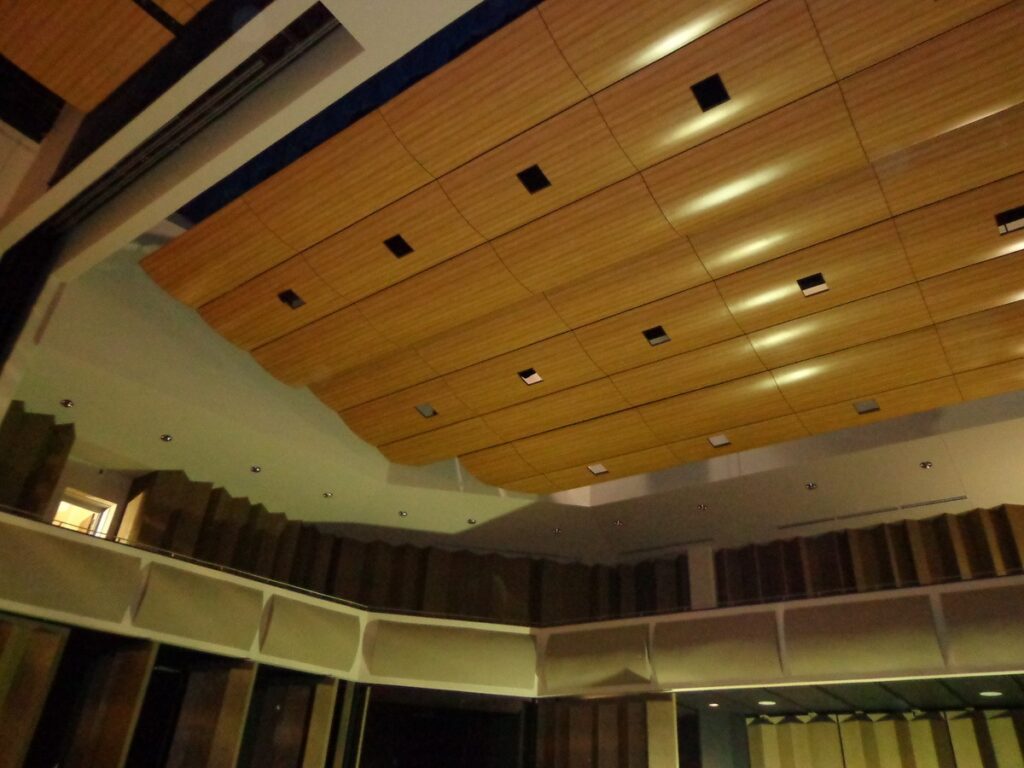
Theatres are full of hard surfaces: ceilings, walls, floors, seats and windows. When speech, music and sound effects hit those surfaces, the sound waves bounce around the room, creating reverberation and echoes.
That can break the spell onstage and distract the audience.
Acoustic stage banners and panels offer a solution, especially for multipurpose venues. This article compares the two and explains how to choose the best option for your space.
What Is an Acoustic Stage Banner?
An acoustic stage banner is a heavy fabric curtain that absorbs sound in theatres and around stages. Banners come in motorized, manual and dead-hung designs, so you can match the system to the level of control you need. They typically hang from ceilings, along side and rear walls and in the fly area. Banners are made from wool, velour, velvet and polyester, and you can layer those materials to adjust the level of sound absorption.
Acoustic banners are most effective on mid- and high-frequency sound, including speech and most instruments. Low-frequency sound, such as bass, has longer wavelengths and requires double-layer banners or an air gap behind the fabric.
What Are Acoustic Panels?
Acoustic panels are permanent sound-absorbing structures that mount to walls and ceilings. Once installed, they stay in place. Most have a frame, core and covering. The core may be fiberglass, rockwool, wood wool or foam, and each material offers a different degree of absorption.
Fabric-wrapped panels use acoustically transparent fabric that lets sound reach the absorbent core. Rigid panels have hard surfaces with perforations, slots or grooves over an absorptive backing.
Thicker cores absorb a wider range of frequencies. A 1-inch fabric-wrapped panel works well on mid- to high-frequency sound, while a rigid, slotted design can target low- to mid-range frequencies.
Key Differences Between Acoustic Banners and Panels
Acoustic Banners
- Adjustability: Deploy fully or partially to match the acoustic demands of each performance or presentation
- Coverage and ceiling height: A single banner can cover hundreds of square feet on walls or in overhead spaces
- Installation and rigging: Requires overhead structure and rigging hardware; retractable systems also need storage space
- Visibility: Usually visible when deployed, but hidden when retracted
Acoustic Panels
- Adjustability: Provide the same level of absorption at all times; adjusting requires removing and reinstalling them
- Coverage and ceiling height: Large auditoriums may need many panels; best for targeted treatment
- Installation and rigging: Mount with Z-clips or adhesives; require little to no structural engineering
- Visibility: Always visible, with customizable fabrics, finishes and colors
How to Choose an Acoustic Treatment for Your Venue
Consider these factors when choosing between acoustic banners and panels:
Venue size: The size and volume of your performance space determine how much absorption you need. A black box theatre may need only a few hundred square feet of coverage, while an auditorium with thousands of seats will demand significantly more. Also consider how much wall space is available for treatment.
Ceiling height and structure: Banner systems need overhead space and structural support. If your theatre lacks either, panels may be your best option.
Operational requirements: If your venue hosts many types of performances, a motorized banner system makes adjusting the acoustics easier, though staff will need training. A theatre that stages one type of performance may be better suited to stationary panels.
Budget: Panels usually cost less to install because banner systems add rigging, structural and electrical expenses. But the cheaper option won’t always deliver the sound control your venue needs.
Long-term maintenance: Banner systems include motors, cables, pulleys and fabric that require regular inspection. Because panels don’t move, they need far less upkeep.
Best Venues for Each Option
Acoustic banner systems are effective in:
- Performing arts centers
- Concert halls
- Large high school auditoriums
- Multipurpose venues
- Historic theatres
Acoustic panels are best suited for:
- Black box theatres
- Small community theatres
- Rehearsal spaces
- Lecture halls
Can You Use Acoustic Banners and Panels Together?
Yes, and combining them is often the ideal solution for mid-size and multipurpose theatres. Panels provide baseline absorption, and banners add an adjustable layer you can deploy and retract as needed.
Install panels where echoes are a constant problem, such as rear house walls, balcony fronts, side walls near the stage and around control booths. Add banners on upper side walls, in overhead spaces and around the orchestra pit to adjust reverberation for each event.
Get Expert Acoustic System Design Support from Tiffin Scenic Studios
Every performance space has unique acoustic characteristics, and designing sound control for each one takes expertise. Tiffin Scenic Studios has worked with theatres across the country, crafting custom acoustic banner systems around the structure and performance requirements of each venue. Contact us to learn more about our stage rigging products and service capabilities