

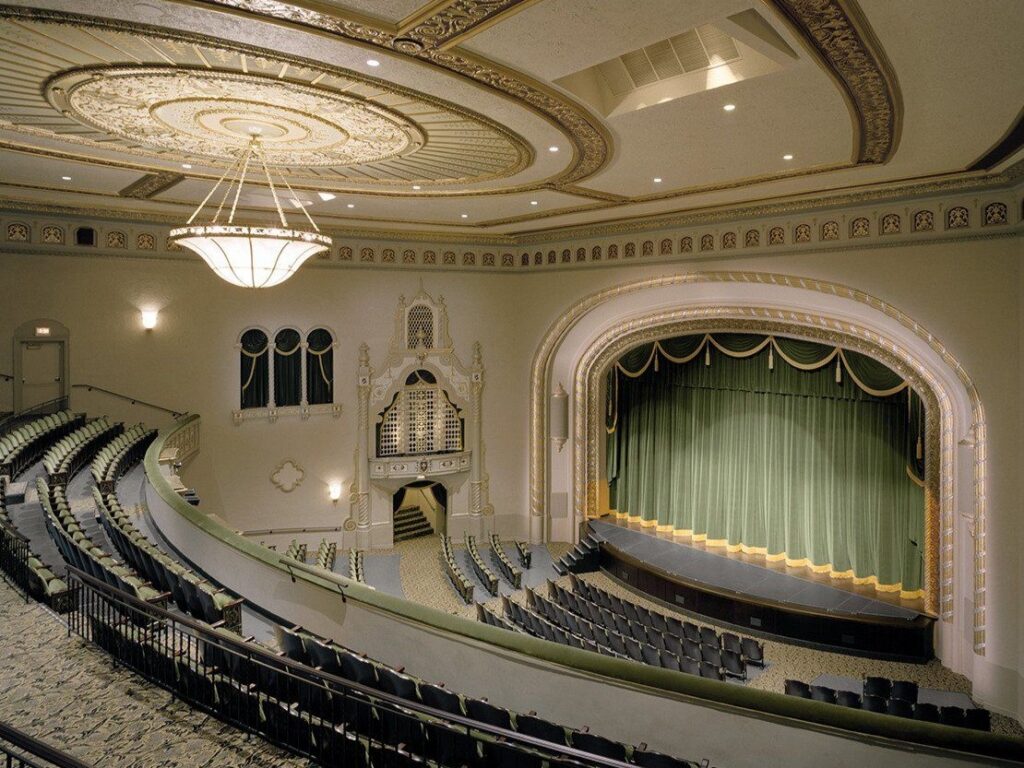
An effective theatre is the sum of its parts, and those parts must suit your unique venue. Historic theatres have different requirements than new builds; a school stage won’t require the same equipment as a professional performance space.
With so many options available, it can be hard to know where to start. Understanding the most common types of theatre equipment will help you determine what your venue needs.
Read this guide for a breakdown of common essentials.
Types of Stage Curtains You Need in Your Theatre
Main curtain or grand drape: The large curtain at the front of a stage behind the proscenium arch is called the main curtain, act curtain or grand drape. It frames the performance area and opens and closes to mark the beginning and end of a show. Main curtains are also aesthetically pleasing and give theatres a polished, professional look.
Valances: These short horizontal drapes hang across the top of the stage, just in front of the main curtain. They’re designed to hide tracks and rigging and provide a decorative finish.
Legs and borders: Legs are long vertical drapes hung on either side of a stage behind the main curtain. Borders are short, horizontal and placed across the top of a stage. Together, they hide the wings and overhead rigging and direct the audience’s focus to the performance.
Travelers: A traveler is a type of theatre curtain that moves sideways on a track. You can hang travelers as grand drapes or mid-stage to hide crew and scenery movements during transitions without closing the main curtain.
Cycloramas and scrims: A cyclorama is a seamless, light-colored backdrop that serves as a canvas for projected color, imagery and lighting effects, allowing you to shape the mood of a performance. A scrim is a loosely woven, gauzy fabric that is almost transparent when lit from behind but solid when lit from the front. Both give you design flexibility for visual effects.
Fire curtains: These curtains are made of fire-resistant materials or coated with a treatment that slows burning. Hot lights, wiring and dry materials can pose safety hazards in a theatre, so fire curtains are a must for containing flames and smoke. They’re also typically required by local fire and building codes.
Essential Curtain Tracks and Stage Hardware
Curtain track systems: Curtain tracks come in a variety of setups that serve different functions:
- Center-opening track: Two panels meet center stage.
- One-way draw: A curtain draws in one direction from one side of the stage to the other.
- Straight track: A single straight track spans the width of the stage.
- Curved track: A bent track follows the curve of a stage or wraps around a performance area.
- Motorized track: Electric motors open and close curtains at the push of a button.
- Rope-operated track: Stagehands manually pull ropes to open and close curtains.
Battens: Also called pipes, these horizontal bars hang above a stage and support curtains, scenery and lighting equipment. They’re usually made of steel or aluminum and can be raised or lowered in a fly system.
Mounting hardware: Ceiling and wall brackets, batten clamps, carriers, shackles and tie lines connect tracks, battens and curtains to the building and secure suspended equipment.
Theatre Rigging Systems
Counterweight rigging: This manual fly system uses steel weights loaded onto an arbor to balance each batten. Ropes or cables run through pulleys to a batten, which is raised and lowered by hand to move scenery, drapes, lighting and sound equipment.
Motorized rigging: A control panel directs electric motors to raise and lower battens. This type of rigging is well suited for heavy loads and complex movements.
Dead-hung rigging: This rigging hangs at a fixed height from cables or hardware. You can adjust it manually between productions, but it can’t be flown in or out during a performance.
Grid systems: Pipe and tension wire grids are overhead networks for hanging curtains and equipment. Tension wire grids also provide a walkable surface that makes it easy for technicians to access and adjust lights.
How to Choose the Right Theatre Rigging Supplies for Your Venue
Start by considering how you’ll use your space. Are you putting on plays, presentations or concerts? A combination? Your rigging should accommodate every type of event you host. Your building’s fly space and load capacity will also shape your options.
Think about how often you’ll need to move drapes and the size and skill level of your crew. Manual rigging requires training and endurance, while motorized rigging demands technical expertise but is physically easier on stagehands. Motorized systems also cost more up front.
When budgeting, account for the cost of:
- Materials
- Installation
- Building modifications (if necessary)
- Inspections and maintenance
- Operator training
The initial sticker price may seem daunting, but it’s important to think about the long-term value of investing in quality equipment. Durable pieces are easier to maintain and may require fewer repairs and replacements.
Outfit Your Theatre with Confidence
Selecting theatre equipment can be a lot of work, but an expert rigging supplier and installer can simplify the process. Tiffin Scenic Studios has more than 100 years of experience designing and building custom rigging solutions for theatres across the country. Learn more about our services and contact us to schedule a consultation.